Building a unified wireless edge for expanding enterprises
March 4, 2026
The traditional office perimeter has vanished. Today, business happens in clinics, warehouses, retail sites, job sites, vehicles, embedded systems, and the hands of mobile workers. This is the new wireless edge, a shifting environment where people and machines require more than just a signal; they require an active, intelligent control system.
The new requirements at the wireless edge
Modern operations demand more than bandwidth; simple connectivity is no longer enough. To thrive at the edge, organizations need high-performance systems that prioritize intelligent network operations over raw throughput. They require:
Resilience across multiple carriers and networks
Application-aware performance
Visibility across fixed sites, mobile users, and embedded devices
Rapid & easy installation without onsite complexity
Consistent policy enforcement across diverse environments
Infrastructure that can support AI-driven workloads
Real-time diagnostics & troubleshooting that identify issues before impacting users
In short, the edge must become intelligent and pervasive. Connectivity must evolve from a passive transport layer into an active control system.
Unlock lightning-fast 5G internet almost anywhere
From 5G devices to intelligent wireless edge systems
To meet these needs, 5G hardware must do more than connect to a network. It must operate as part of an integrated system that understands applications, manages multiple carrier links simultaneously, and adapts in real time.
This is why we are transforming our portfolio of fixed wireless, IoT, and mobile router solutions into intelligent, multicarrier, AI-driven systems at the wireless edge based on the Qualcomm Dragonwing Gen 4 solutions. The Dragonwing Gen 4 platform shifts the modem from a passive transport layer into an active control system by embedding AI directly into the connectivity layer.
Enables two active carrier connections from a single modem and RF subsystem with Dual SIM Dual Active (DSDA)
Uses integrated intelligence to steer traffic and balance loads, ensuring that latency-sensitive applications remain optimized without interruption.
Rather than traditional failover, the system understands application requirements and prioritizes critical data across active links in real time.
Delivers greater resilience for distributed enterprises and more differentiated, SLA-driven offerings for service providers
By integrating these capabilities, the wireless edge ceases to be a point of potential failure and instead becomes a reliable, self-optimizing foundation for the enterprise. This shift ensures that connectivity is no longer just a background utility, but a strategic asset that actively protects business continuity across every distributed location and mobile user.
The wireless edge now includes individuals
For years, enterprise connectivity strategies focused primarily on fixed locations and embedded systems. But the edge now includes individuals. Mobile professionals, field technicians, healthcare workers, media crews, and public safety personnel require the same level of performance, policy control, and security as a branch office.
That is why a comprehensive wireless edge strategy must span:
Fixed wireless for primary and backup WAN at branch locations
Industrial IoT for fleets, utilities, logistics, and embedded deployments
Mobile routers that extend secure, managed 5G connectivity directly to individuals in motion
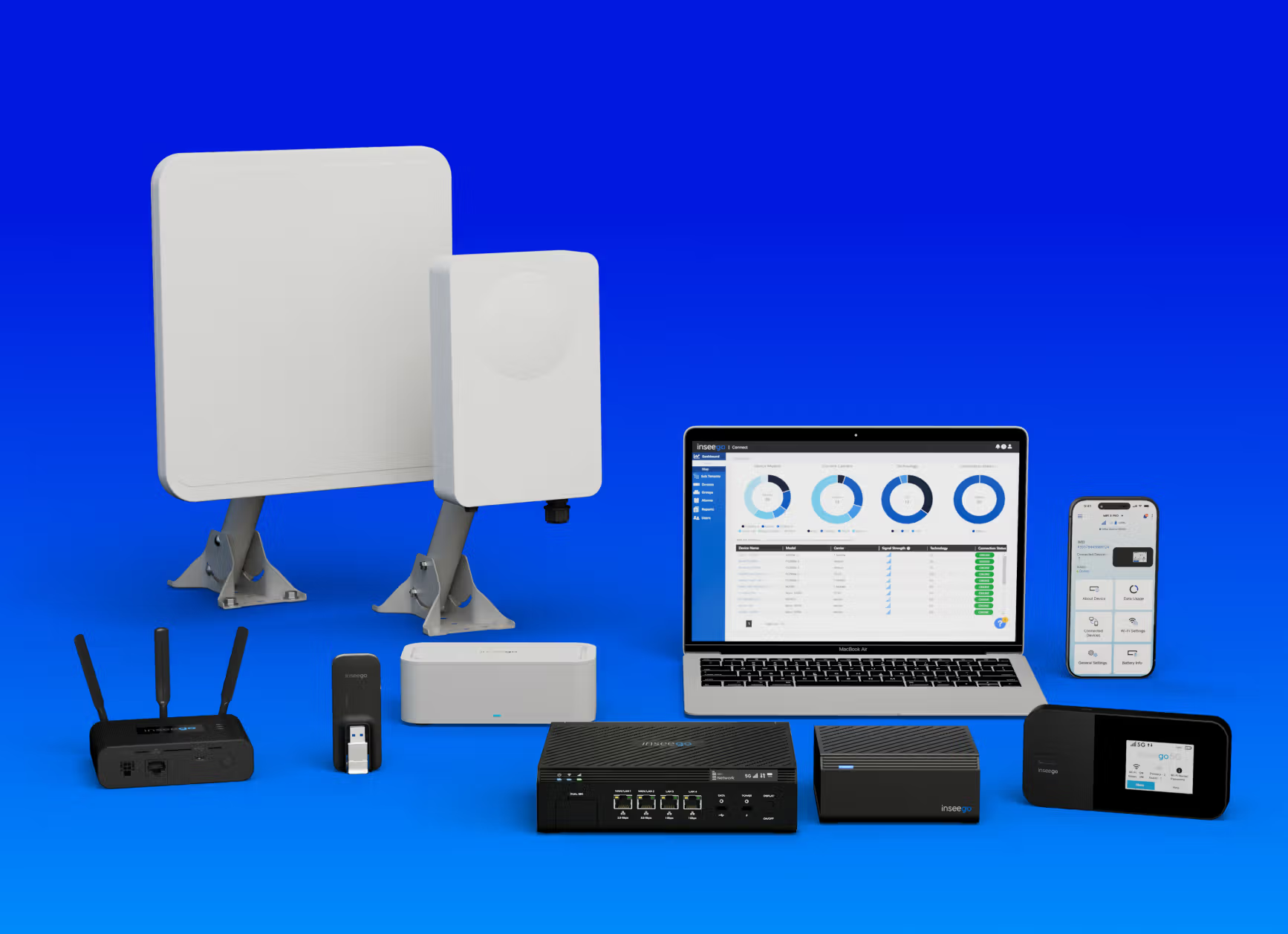
The Inseego portfolio
Architecture as an operational strategy for the wireless edge
When these categories operate on separate architectures, enterprises face fragmented management and operational complexity. True architectural consistency is the only way to meet the demands of a fluid, expanding edge. By building a portfolio on a single 5G module architecture in the United States, we deliver a shared and secure hardware foundation that spans fixed wireless, industrial IoT, and mobile routers.
A unified module architecture delivers practical business advantages:
Consistent feature sets and behavior across device types
Faster innovation cycles and simultaneous feature rollouts
Optimized performance across hardware and software layers
Economies of scale that improve cost efficiency
For service providers and enterprise IT teams, this consistency simplifies validation, certification, deployment, and lifecycle management. It ensures that multicarrier capabilities, WAN intelligence, and security policies operate uniformly across environments.
Integrated cloud intelligence to orchestrate the wireless edge
Hardware alone cannot manage a dynamic edge. Intelligence must be centralized, scalable, and policy-driven. That is why cloud-based management must be integral to the system, not an afterthought.
Through our cloud platform, organizations can:
Provision devices at scale with zero-touch deployment
Enforce consistent policies across locations and users
Monitor application-level performance across active WAN links
Automate optimization based on real-time network conditions
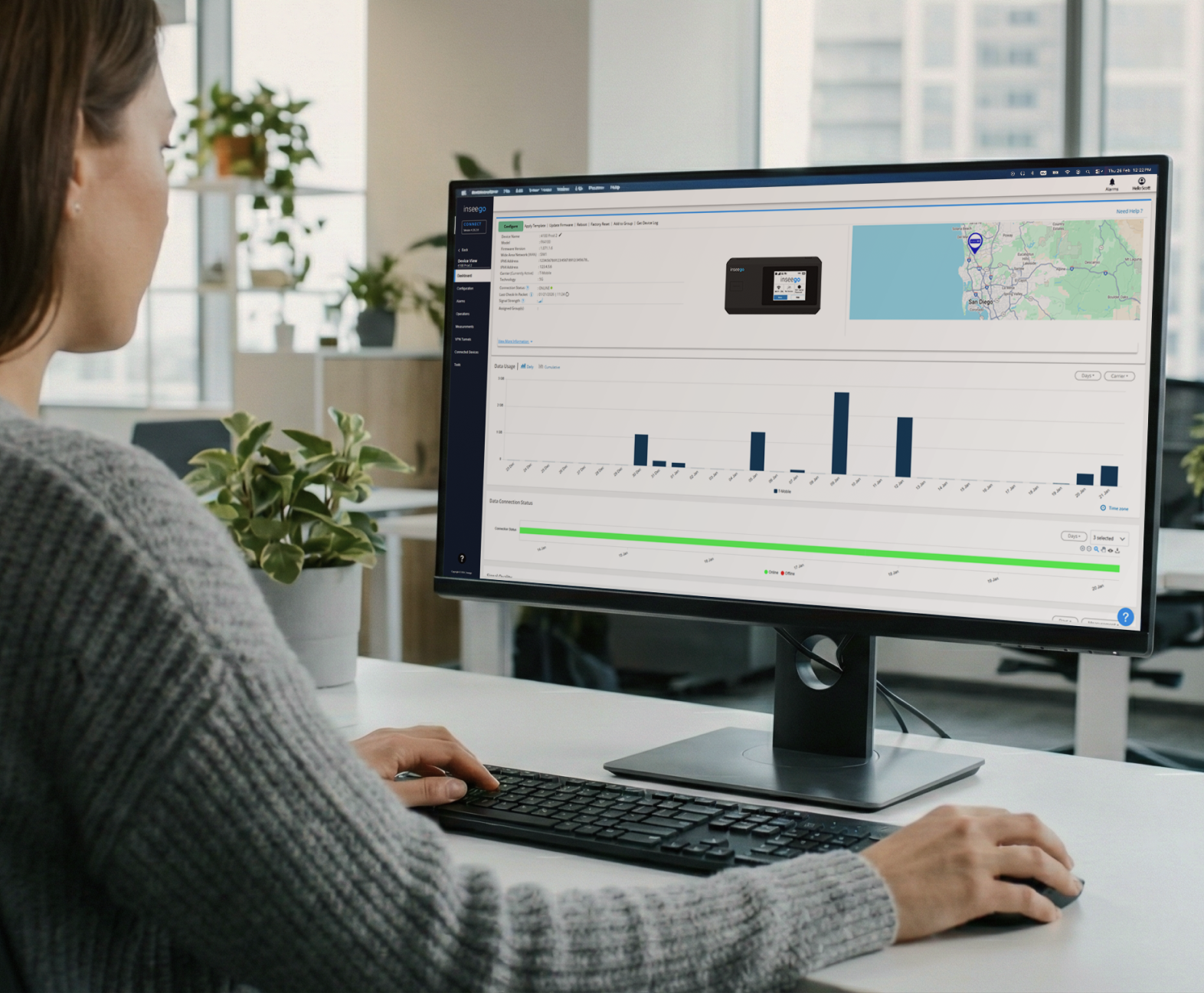
Inseego Connect
When cloud intelligence and edge hardware operate as a single system, enterprises gain the ability to manage fluid environments with precision.
Preparing for the AI-native wireless edge
As AI workloads move closer to users and devices, connectivity must support higher uplink capacity, lower latency, and predictable performance. Features such as enhanced uplink, dynamic network slicing, HPUE options, and next-generation Wi-Fi become foundational.
To support this reality, wireless edge architecture will use the Dragonwing Gen 4 as a foundation, which enables AI to create a self-healing environment through:
Analyzing network health and automatically steering critical applications to the best available link before a disruption occurs.
Dynamically distributing data across multiple carriers to ensure latency-sensitive applications like voice and video remain optimized continuously.
Algorithms that adjust performance levels to maximize battery life for mobile professionals without sacrificing high-speed output.
Running real-time diagnostics and troubleshooting, identifying potential hardware or signal issues before they impact the end user.
Using cloud intelligence to push consistent security and performance updates across thousands of devices simultaneously based on real-time conditions
By building this foundation, technology stops being a bottleneck and instead becomes the primary objective: enabling businesses to operate confidently in an environment where the edge is everywhere and constantly evolving.
The future of the wireless edge
The wireless edge is no longer a boundary or a remote outpost; it is the primary operating environment of modern business. As the perimeter continues to dissolve, the distinction between a fixed branch office, a mobile professional, and an autonomous machine disappears. To succeed in this reality, connectivity must evolve from a passive utility into an active, intelligent control system.
By unifying hardware architecture, integrating cloud intelligence, and pioneering technologies like DSDA, Inseego is providing the framework for this evolution. This approach ensures that as your business expands, your network doesn’t just keep up, it scales with intelligence and intent.
Technology alone is not the final objective. The goal is to enable organizations to operate with absolute confidence in a world that is distributed, mobile, and increasingly AI-driven. That is the future of enterprise 5G, and that is the foundation we are building today.
Talk to our experts!
Set your customers or business up with the fastest, most secure, easiest, most reliable fixed wireless solutions.